¶ Launch memcache
Each web origin has the memcached server software installed (as well as php-memcached). To run an instance of memcached for your web site, create a "forever" cron job with the following command:
/usr/bin/memcached -m 64 -s /home/sites/SITE/include/memcached.sock
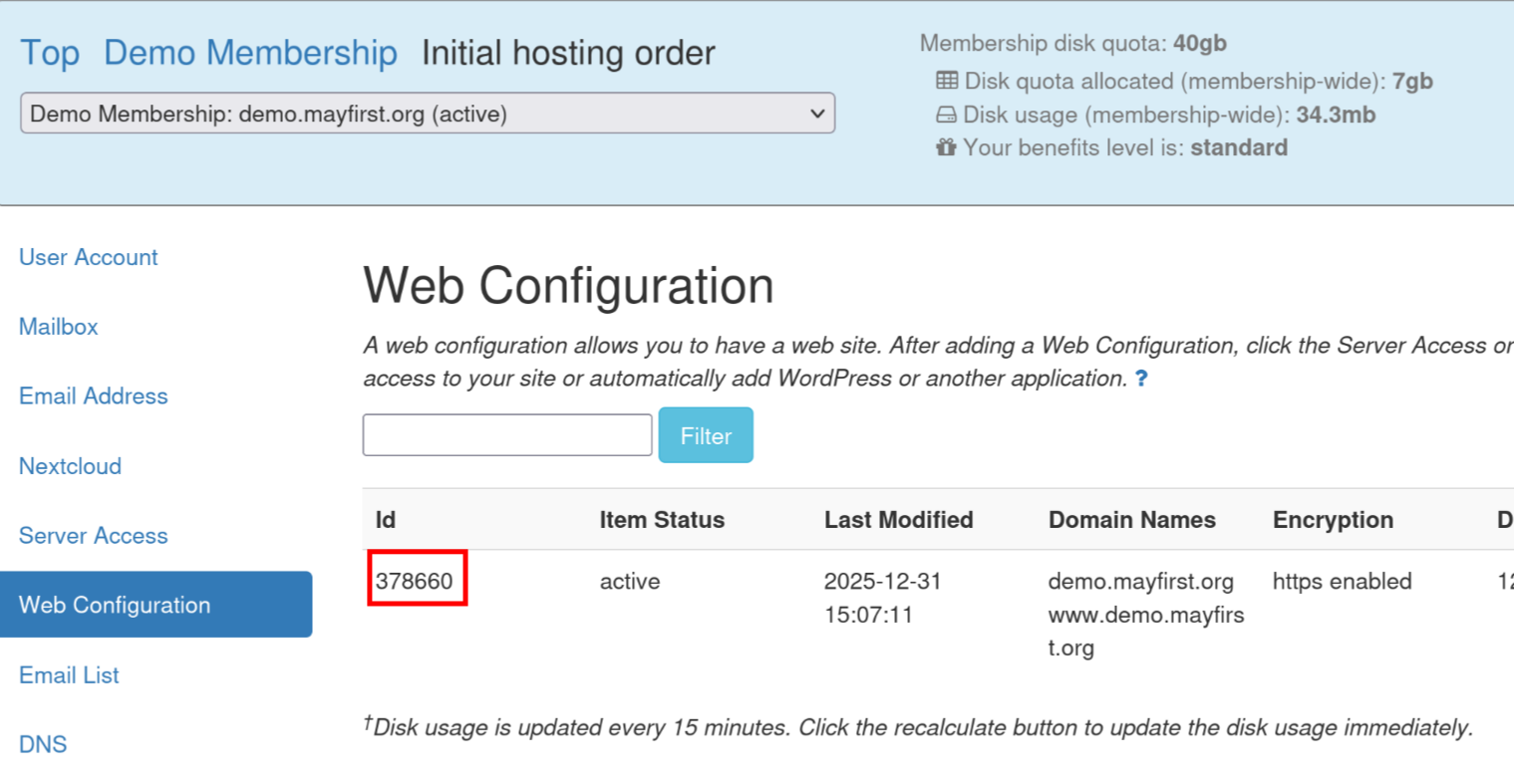
Replace "SITE" with your actual site number. Your "SITE" number can be found in the control panel in your "Web Configuration". For example, the site number for this site is 378660:
In your software, connect to the memcached by specifying the path to the socket (/home/sites/SITE/include/memcached.sock, again replacing "SITE" with your actual site number).
¶ Generic instructions
For example, here is a PHP script:
<?php
$sockPath = '/home/sites/SITE/include/memcached.sock';
$port = 0;
$memcached = new Memcached();
$memcached->addServer($sockPath, $port);
$key = 'mykey';
$value = 'Hello, Memcached!';
$expiration = 900;
$memcached->set($key, $value, $expiration);
?>
¶ WordPress
If using with a WordPress site, you can install the Object Cache 4 Everyone plugin and add the following to your wp-config.php file:
define('OC4EVERYONE_MEMCACHED_SERVER', '/home/sites/SITE/include/memcached.sock:0');
¶ Usage Statistics
This test sript provides some statistics from the server. You'll want to ensure you are seeing things like cmd_set, cmd_get, get_hits, etc are pretty high values. If they are under 100, it's probably not being used at all.
<?php
print "<html><body>";
$sockPath = '/home/sites/<<siteId>>/include/memcached.sock';
$port = 0;
$memcached = new Memcached();
if (!$memcached->addServer($sockPath, $port)) {
 print "Failed to add server.";
 exit(1);
}
print "<p>Connected to server OK.</p>";
$key = 'mykey';
$value = 'Hello, Memcached!';
$expiration = 900;
if (!$memcached->set($key, $value, $expiration)) {
 print "Failed to write value.";
 exit(1);
}
print "<p>Wrote value to server OK.</p>";
$stats = $memcached->getStats();
print "<p>Stats acquired.</p>\n<ul>";
foreach($stats as $srv => $srv_stats){
 print("<li>Server: $srv</li>");
 print "<ul>";
 foreach($srv_stats as $k => $v){
 print("<li>$k: $v</li>");
 }
 print "</ul>";
}
print "</ul>";
print("</body></html>");
?>